Going East

I guess my New Year’s resolution should be to write more regularly. We are just about done here. I expect this will be our last note. We hope to hear from all of you over the coming weeks. Just let us know how you are doing. Thank you.

Victoria cont’d

Our last note ended in Lakes Entrance near the border between Victoria and New South Wales. We headed inland from there on the Great Alpine Road to explore some of the mountainous regions. Many of these regions are ski areas in winter. While there, Liane and I developed a theory that Australia ends at 1000 meters altitude. Above that all maps should just show a great fog of uncertainty and the legend “Here Be Monsters.” The fog made the driving very challenging but we survived (although I think the brakes on the van lost a month’s life in a day).

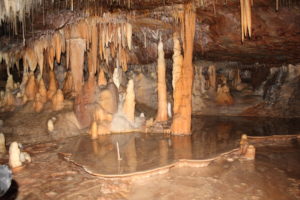
As a bit of a break, we took a half day underground at the Buchan caves (the first of two sets of caves on this trip).
New South Wales

We entered New South Wales through the inland roads, after discarding half our food due to quarantine regulations. We promptly made our way back to the coast, which we both love. We spent a couple of days in Merimbula and then headed to Jervis Bay before finally stopping for most of a week in Gerroa at Seven Mile Beach. Gerroa is just a nice quiet place where we sat around and did nothing. The highlight was watching the pelicans from the best site in the campground.

After our rest, we headed for the region that was the land-based highlight of our previous visit to Australia – the Blue Mountains just west of Sydney. The Blue Mountains are a national park region containing a large escarpment with many waterfalls and walking trails.

The scene below is typical of the Blue Mountains. If you look closely at the right hand edge you can see the blueness for which the mountains are named. It is caused by oils released into the atmosphere by the eucalyptus trees.
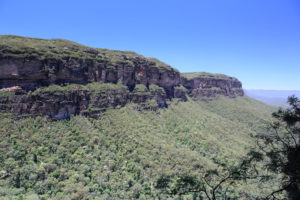
Our personal favourite hike is called National Pass. We liked it so much we did it twice on this trip. It starts with a long stair climb down beside the Empress Falls.
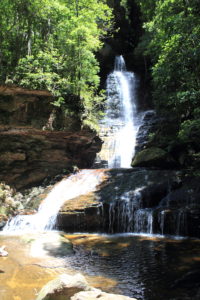
While it seems like you are climbing a long way, most of the falls are still below you as the track follows a path halfway down the cliff face. In the first Blue Mountains picture, the path is in the band of greenery part way down the cliff. Here is a shot from the trail.
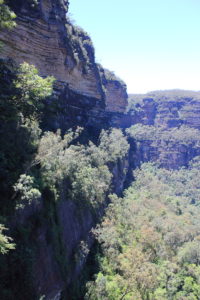
The path leads across the face of the escarpment and encounters many small waterfalls. After an hour or so, it reaches Wentworth Falls.
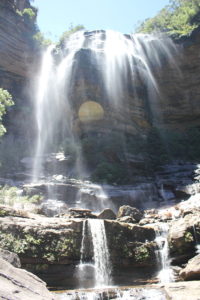
From Wentworth Falls, one climbs many stairs upward to the end of the National Pass. Then there is an almost equally beautiful “Undercliff/Overcliff Walk” along the edge of the cliff to get back to the cafe for a well earned snack. We spent five days driving and walking in the Blue Mountains. I’ve had a couple of people ask “What are the must-do things in Australia?” National Pass makes my list.

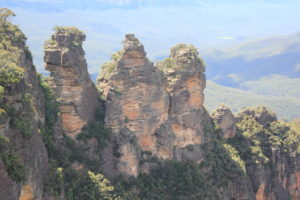
Seeing the “Three Sisters” rock formation is, for some, synonymous with visiting the Blue Mountains so I’ll include a picture here. There are constant bus tours past this viewing point. I have to say that almost any of the hikes offer views that are equally impressive.
This time also included our second cave touring day which we spent at Jenolan Caves on the western edge of the Blue Mountains.
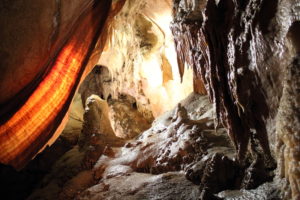
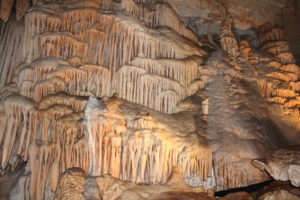
I’d like to add that the drive in to Jenolan in the camper van had some of the more exciting moments of our trip. It has a couple of switchback turns that are simultaneously sharp enough and steep enough that I was concerned the van might tip without leaving the road.

After spending our time in the Blue Mountains we headed back toward Wollongong where we spent Christmas, New Years and the last couple of weeks of our trip. Wollongong has been a quiet time for us. In part, the weather has not been friendly to outdoor activities. Also, on the first day I did decide to go swimming, I got stung by a Blue Bottle jelly fish. The rest of the world calls these the Portuguese Man O’War. Fortunately it was a small sting but it still made me ill for half a day. Nasty creature. We read in the paper that they closed the beaches later that day due to the large number of stings occuring.

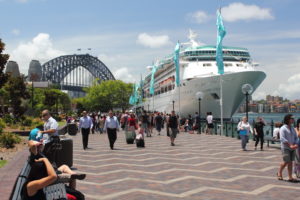
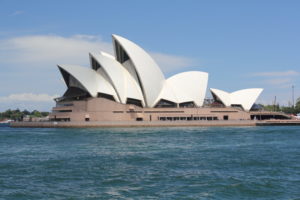
We’ve also had a good day in Sydney where we walked the main tourist area around Circular Quay including views of the Coat Hanger bridge and the Opera House. We hope our last couple of days here will include some more swimming, without the jellyfish, and another trip or two to Sydney.
In terms of the weather, we are well outside the flood regions of southern Queensland and northern New South Wales. The pictures coming out of that region are shocking though. Whole towns are just floating away. The official word is that it is only going to get worse. In our region, the main impact has been trouble buying things like tropical fruit because the farms, the transportation, or both, are under water.

We are flying back to Canada next week to visit with family and get some skiing in. We’ve had a great time here and are looking forward to future trips. As I said above, please do mail us and let us know how things are going.
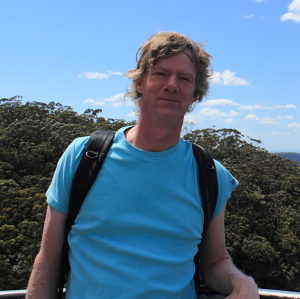
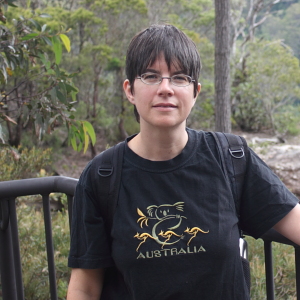
Oh yeah, the hair did eventually get chopped.
Victoria

Well, the season has really changed here. We’ve gone from the cloudy days, chilly evenings and plentiful rain of the Australian spring to the 30+ degree days, humid nights and the sights and sounds of Christmas that mark the beginning of summer. Yep, all the Season’s Greetings and Happy New Year signs are up and little Santas and reindeer adorn the sun parched lawns. That is just SO WRONG.

Victoria

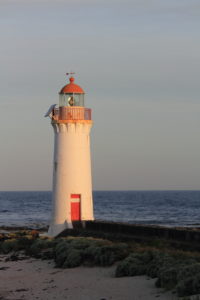
We continued down the Great Ocean Road to Port Fairy where we spent a couple of days including an evening walk out to Griffith Island to see a bird colony. While we missed the birds, the lighthouse looked great.

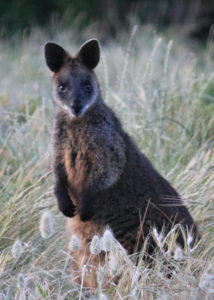
We also saw an assortment of wallabies (shown later).

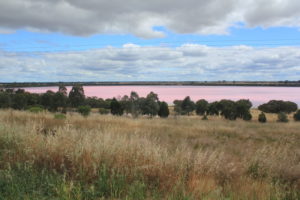
We toured a bit more of the coast and some of the inland salt lakes. While most of the lakes were a light lime green, we did come across this pink lake. The colour is caused by some algae that release beta carotene into the water.

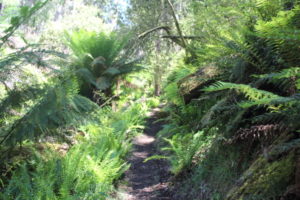
We then headed inland to visit The Grampians. These are a small range of mountains in central Victoria with some great day hikes. We spent three days there and did several walks. Here are a few pictures, starting with just a section of trail to give a feel for it.

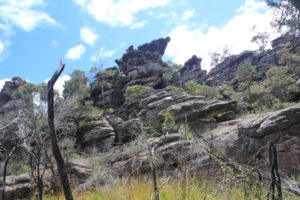
When we got out on top, it was mostly interesting rock formations.

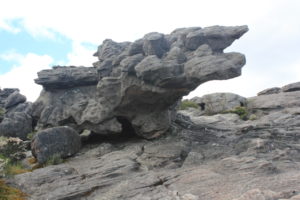
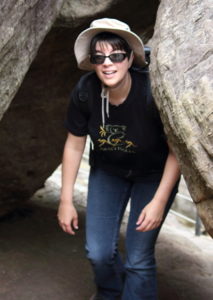
We saw this rock on our way out to a viewpoint and ended up having lunch underneath it as it was the only shade in the area. The picture doesn’t really capture the size of it – suffice to say it covered both of us very comfortably.

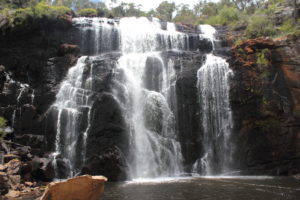
The McKenzie falls are, in some sense, the showpiece of the Grampians. They are reached by a steep staircase that could be a bit trying in high heat but was quite manageable on our trip.

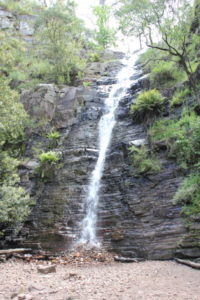
I also liked these smaller falls, called SilverBand, for what isn’t present.

There is no pool of water at the bottom or river continuing on. The water hits the pile of rocks and is immediately channeled underground.

We drove back down for a couple more days on the coast before heading to eastern Victoria on our way to the border with New South Wales. We needed a quick stop in Melbourne to get a minor repair done on the camper and then it was off to Phillip Island, a small vacation area east of Melbourne. I think we went there for the Chocolate Factory but we also took a walk through a wetland bird sanctuary at Churchill Island.

From Phillip Island, we headed south to Wilson’s Promontory – a national park on the south coast. More great beach views and some good walking. Unfortunately this was our first really hot day and we both ended up with minor heat issues that caused us to abort one walk and take it easy for a day or two. We are now spending a few days in the town of Lakes Entrance where we’ll do a couple of local day cruises (“Five passengers set sail that day, for a three hour tour, a three hour tour…”) and probably treat ourselves to an evening out.

Wildlife

I haven’t written much about the wildlife here since leaving Cairns. One of the great things about hiking in Australia is the incredible number and colours of birds. While they are impressive to see, the sounds while hiking are even more surprising. You have a constant background of screeches, laughter (Kookaburra), and music around you.

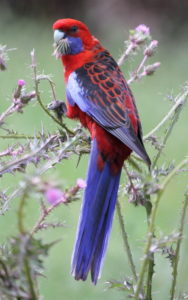
These red and blue parrots, Crimson Rosellas, are very common but for quite a while all we saw were flashes of colour through the trees that disappeared as soon as I grabbed a camera. Liane thought it very funny. Anyway, we saw this one on a walk in Hall’s Gap, Grampians. Once I got the first picture, we saw them everywhere.

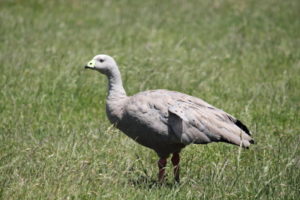
On Phillip Island, we saw hundreds of these Cape Barren geese with lime green bills.

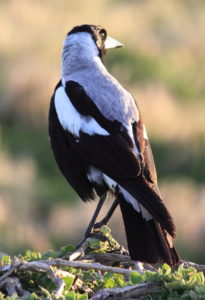
Even the Australian Magpie, the local scavanger equivalent of our crow, is interesting to look at and has a much more pleasant call than its north american counterpart. The picture is from Port Fairy, but the birds are everywhere.

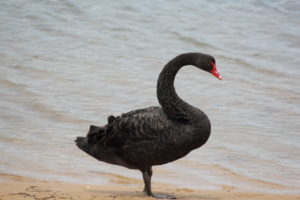
The native Australian swan looks very similar to what we see in Canada, except it is black. This picture is from Lakes Entrance. The “lakes” at Lakes Entrance are at least part tidal lagoon and the swans like the mixed waters for feeding. The region where salt and fresh water mix churns up the sea grasses and the swans crowd the area.

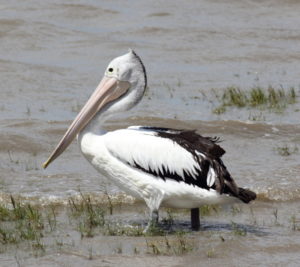
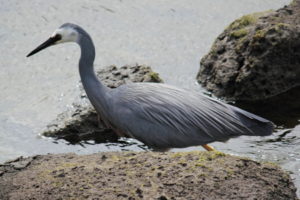
While on the topic of birds, I’d also like to throw in these pictures of pelicans and a heron from earlier in the trip.

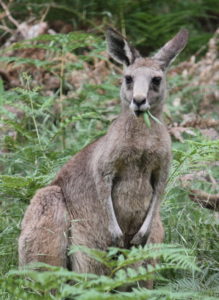
In addition to the birds, we are seeing plenty of kangaroos and wallabies. The wallaby picture was taken in Port Fairy. The kangaroos were seen on the same walk as the parrot picture above in the Grampians.

I should mention that I think the second is a kangaroo not a wallaby. The differences can be a bit subtle and properly distinguishing them seems to involve dentistry. Unfortunately, I still haven’t seen a koala in the wild. Still a couple of months to go.

One final wildlife shot before I go.

Headed South

Just a quick note to update you on where we are and how things have been going. On the plus side, all the locals are ecstatic that their ten year drought is over and the reservoirs are hitting levels not seen in years. Unfortunately, rain and pictures really don’t mix. Overall though, we are seeing some beautiful country and enjoying ourselves immensely.

Queensland (cont’d)

We spent our few days in Mission Beach and then headed back to Cairns for another night before heading to Brisbane. Our few days in Brisbane were quiet and not very photogenic. We spent our time walking along the river bank and enjoying the cafés and restaurants we came across. We have always found Australian restaurants a level above what we are used to in North America and Brisbane did not disappoint.

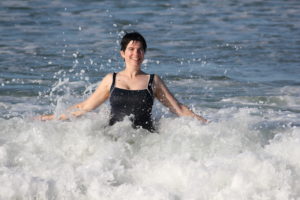
From Brisbane we headed north to the surf beaches of the Sunshine Coast. Unfortunately my plans to try surfing were grounded by a mildly twisted ankle (surprise). Maybe Sydney. We rented a small apartment by the ocean in Mooloolaba for 10 days and spent our days relaxing, playing in the surf, walking and then doing some more relaxing. Here is Liane in her element.

Tasmania

After six weeks in Queensland, we flew to Hobart to spend a week in Tasmania. Our time in Hobart included a dinner cruise (becoming a habit), a tour of Bruny island and a failed attempt at the Mt. Wellington lookout.

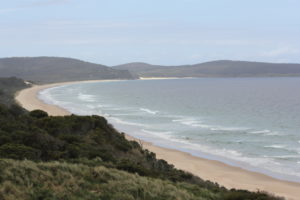
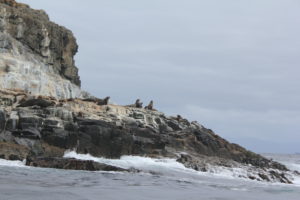
Bruny island is just south of Hobart and has some beautiful coastline as well as seal colonies, and whale and bird watching.

Mt. Wellington overlooks Hobart and offers beautiful views of the city. The picture I took tells the entire story.

Actually it doesn’t quite capture the moment – it misses the camera auto-focus freaking over the lack of anything to get a handle on.

Van Dieman’s Land

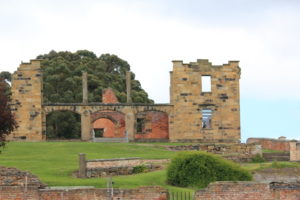
Outside Hobart, our first major stop was Port Arthur which is largely the remains of the old penal colony. This was where the rest of Australia sent its troublemakers. The British took a peninsula connected to the rest of the island by a small spit, placed dogs and soldiers on the spit and built their equivalent of a Super Max. No escaping (absconding) allowed. Well, there was that entire work crew that hopped in the commandant’s whaling boat and headed out without even being challenged (they eventually got caught). Port Arthur was both a prison and a town in that the guards and their families also lived there. While there are some ruins of the old colony left, most of it has been destroyed. The destruction occured for several reasons including fires, scavenging of building materials and finally a desire to erase this aspect of Australia’s heritage. Seeing Port Arthur is a bit odd because you know that it was the site of horrific punishments and essentially slave labours but now all you see is a nice set of pastoral ruins. In many ways, the B&B we stayed at in New Norfolk, later, was more true to history as they had some of the old leg irons, ball and chain sets, and other paraphenalia on display in their restaurant. However eating dinner while facing instruments of torture was a new experience.
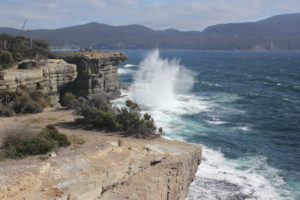
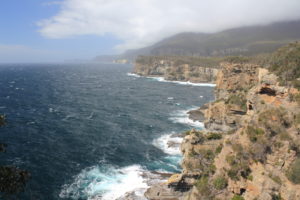
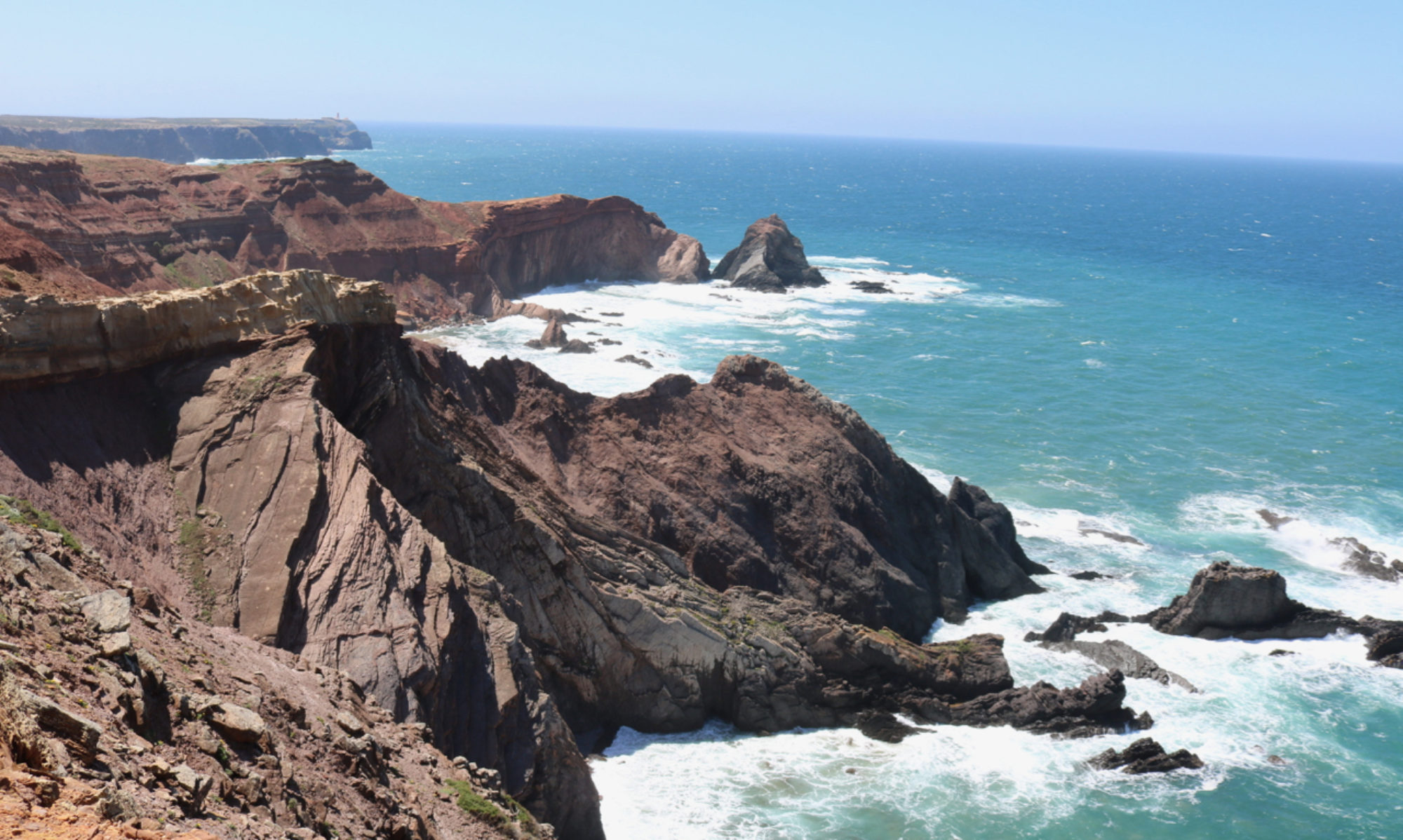
From Port Arthur we drove north along the east coast eventually landing at Bay of Fires near the north eastern tip. The coast of Tasmania offers some great sites and the weather broke for a bit so here are a couple of pictures from the Tasman Arch area.

We then drove back down to New Norfolk for a day before flying off to Melbourne. A week is definitely not enough time for Tasmania. In particular we would have liked to spend some time on the west coast which is supposed to be spectucular. Cause for another trip, I guess.

Victoria

We arrived in Melbourne just in time for the Melbourne Cup. When told this, I immediately asked “Is that tennis or sailing?” Wrong! Horse racing. For us, this meant that many things were closed the first day (state holiday). As well, there were large numbers of people in fancy clothes walking around. Suits, top hats, dresses and ladies hats were all over. Australia takes its horse racing seriously and its betting even more so. “Small” bets seemed to run around $1000 according to one article I read. I think I read something like $100 million might have changed hands when the favourites lost out.

As usual we spent our time walking around the towns parks, gardens and river front as well as the downtown core. Our usual dinner cruise was replaced by an elegant lunch on the city tram network. They managed to pull that off quite well.

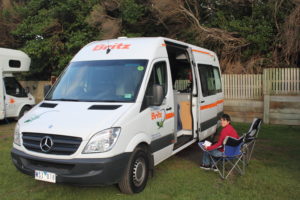
We are now making our way west from Melbourne and then looping back around to Syndey by mid-December. All of this will occur in our new home away from home (or is that just “home” given that we have sold the original?)

We’ve only had the van four days but so far it is working out well. The break from restaurant food is good. As well, I’m enjoying the opportunity to cook with some different ingredients like tamarillo and buckwheat pasta. As we aren’t cooking any meat in the van to avoid odors, I’ll have to wait until Sydney for kangaroo (tastes very much like beef).

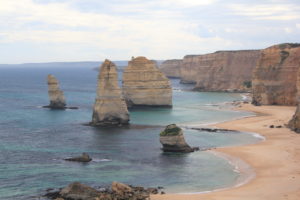
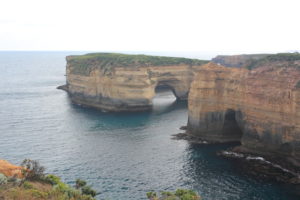
One of our first sites on the road to Adelaide was the “Twelve Apostles” rock formation. These are limestone stacks jutting out of the sea very near to shore. We stopped at various points to see them and take some pictures.

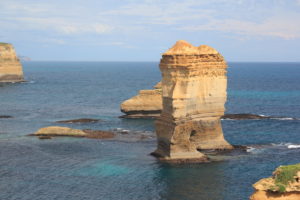
Despite the name, there are supposedly only nine of these now as three fell victim to erosion. Theology not being a strong point of mine, I have no idea of the implications of disappearing apostles (apart from reduced printing costs). Fortunately more are already being formed as shown in this picture.

When an arch collapses, an apostle will be left. The region we are in is called the Great Ocean Road and consists of continuous stretches of beautiful beaches, limestone formations (like the apostles, but unchristened), and scrub bushland.

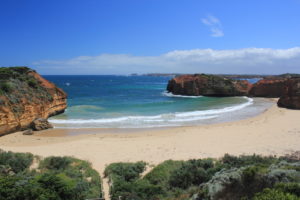
It is a bit odd to see so many incredible beaches that you get blasé about what is in front of you.

We’ll try to update again in a couple of weeks but certainly won’t be surprised if it takes a bit longer. Liane and I have decided that we really don’t do cities well so this section promises to be one of our favourite parts of the trip.

As before, we’d really like to hear how you are doing so please drop us a note. In particular, any descriptions of sub-zero weather or snow are always appreciated.

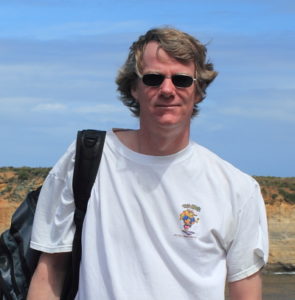
And yes, to my family, I do need a hair cut.

Queensland

We have been in Australia for almost three weeks at this point. We’d like to reassure our friends and family that, so far, we are still alive and speaking to each other. This despite

  1. Sharks on our reef dives (they were really quite small),
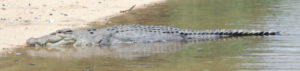
  2. Crocodiles on our river cruise (they appeared bored),
  3. My driving on the left (by far the biggest threat), and
  4. Liane navigating while I drive on the left.

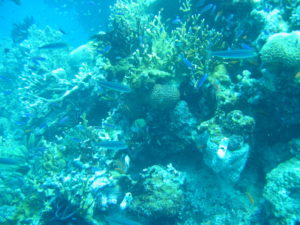
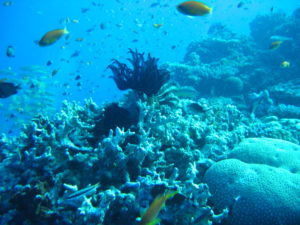
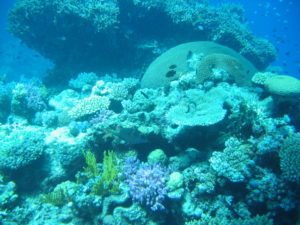
We arrived in Cairns on a Thursday and promptly booked a reef dive for the following Tuesday-Friday. Then we figured we had to find a hotel for Saturday-Tuesday. ?Fortunately?, Liane remembered that we had seen another dive trip out to another reef for Saturday-Monday. We made our way back to the other shop and booked another trip immediately preceding the first one. We had a great time despite being jetlagged and, in my case, lightly seasick. I say lightly because while it didn’t feel light at the time, I was much much healthier than many of the other passengers on the boats. To be blunt, I kept lunch. I definitely wished I hadn’t eaten though. We spend a week diving the various reefs around Cairns. Names like Milln, Agincourt, Cod Hole, and Steve’s Bommie come to mind. Overall, I’d say the fish and non-coral wildlife was a bit more limited than we are used to on our other dive sites (e.g. Mexico or St. Lucia) but the coral and sponges were incredible. Some of the scenes looked like they had to be from another planet due to the variety of unfamiliar shapes.

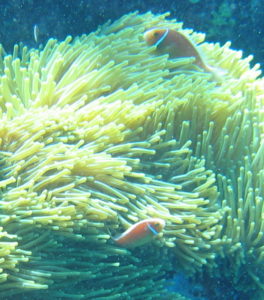
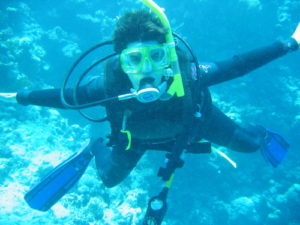
Due to various minor issues we didn’t get many underwater pictures and the ones we got were not well colour balanced. However, here are a few more.

Liane trying to fly.

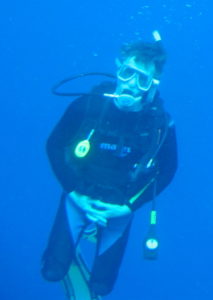
Me on my way back up to the boat.

After diving we spent a few days in Cairns itself. Mainly sleeping, swimming in the pool and eating at nice restaurants. The main goal of this part of the trip was to recover from the hectic dive schedule. You know you have a problem when the walls of the hotel room are still rocking with the wave motion. We did take a side trip to Kuranda which is a local rainforest area. It was a large tourist trap but the cable car ride down had a great view of the canopy of the rainforest and the ways plants manage to reach the canopy and sunlight. Some vines climb up other trees, some have their seeds germinate at the top and then send out “roots” to reach the ground, while other establish their entire existence at the top of existing trees. We rented a car (the agent called it a “silver bullet” – a very optimistic evaluation of its top speed) and headed out to the wilder rainforest to the north. We spent a couple of days up in Port Douglas and Daintree. One of the highlights of this portion of the trip was a river cruise with a couple of crocodiles like this one.

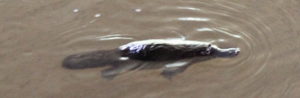
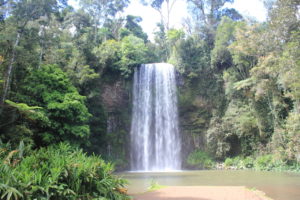
We then spent three days at Kewarra Beach, which is a resort area just north of Cairns. Unfortunately, at this point coastal northern Queensland decided to offer us copious amounts of evidence of why it was called RAINforest. Even the locals were complaining (although the few we saw in sweaters and heavier coats had taken it a bit far). We cowered on the resort and caught up on our travel planning during the deluges. Not many pictures of that portion of our trip. We decided to flee the rain inland and headed up to the plateau areas 30km behind Cairns, The Atherton Tablelands, in a futile effort to locate sun. Instead we came across a couple of platypus – evidently they like the rain, and several waterfalls, which will surely be enhanced by the rain.

Today we came down from the hills, after consulting the Aussie government meteorological service, and arrived at Mission Beach. Liane went in to book a room for the night while I read email in the car (the iPad is working out very well down here – sorry BlackBerry). She came back out and informed me “I fell in love with the place” so we will be at Mission Beach for the next three days.


That is all for now, keep safe and let us know how you are doing.